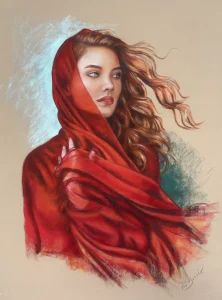

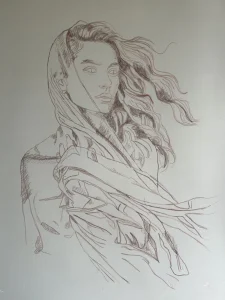
The preparatory sketch
I start by sketching out the portrait and its proportions. I keep the sketch deliberately light, it serves as the framework onto which the light and shadows will later be applied.
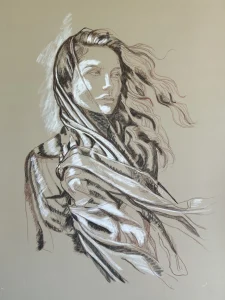
Building Values with Charcoal and Chalk
When working with charcoal, I start by defining the large areas of shadow, and with chalk, the light. At this stage, I’m not really thinking about color yet: I’m building up the volume and light of the face.
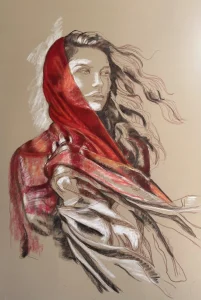
The first layers of dry pastel
The color appears gradually. I apply the first layers without saturating the paper so that I can then build up the pigments. This is precisely one of the key principles of dry pastel: leaving enough texture available for subsequent layers.
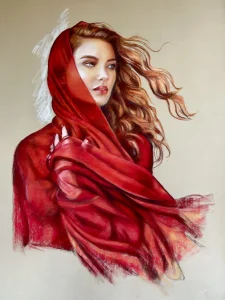
Layers and Glazes
I build up layers of color rather than immediately settling on the final shade. Successive layers enrich the skin tones, shadows, and transitions between light and dark. Glazing, in particular, allows me to lightly cover one color with another while preserving the vibrancy of the underlying layers.
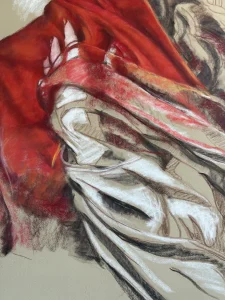
From Bulk to Retail
Once the values and colors are in place, I work more precisely on the eyes, facial features, hair, and certain transitions. Pastel pencils then allow me to achieve greater precision.
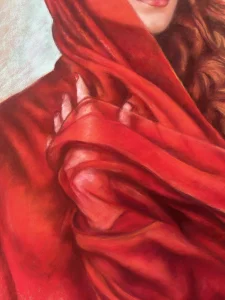
The drapery and the last rays of light
The garment, too, is constructed through layers. I emphasize certain folds, shadows, and highlights to give the fabric its volume and presence, while leaving some areas more open.